
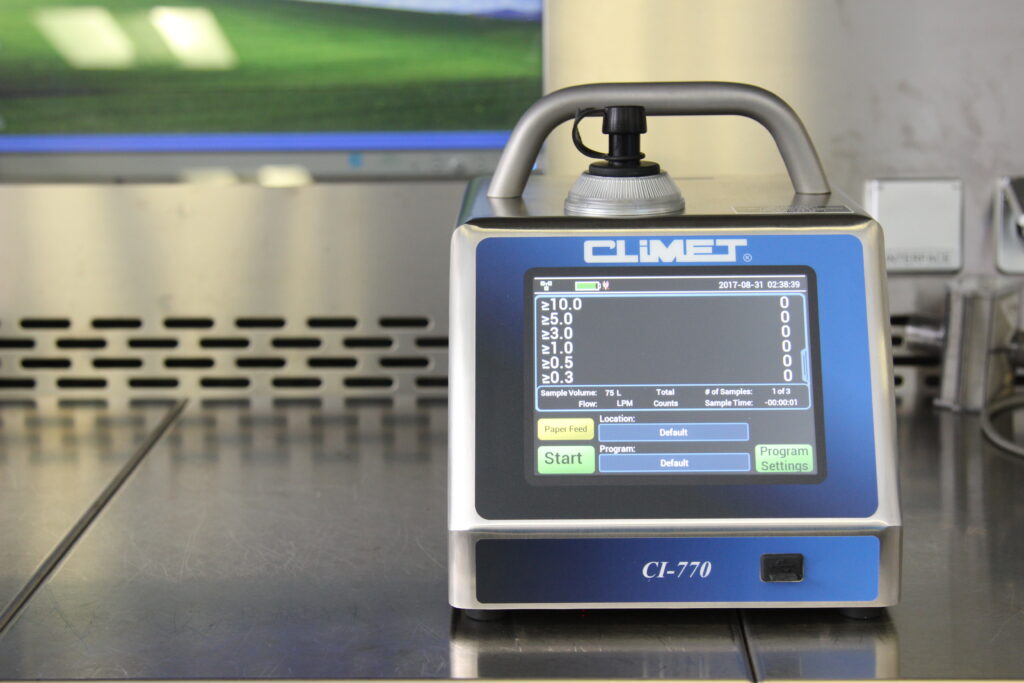
A common trend among particle counter and microbial air sampler manufactures is to forgo quality, drive down costs, and compete based on initial purchase price. One of the easiest ways to accomplish this goal is to produce particle counters and microbial air samplers with plastic enclosures rather than stainless steel. But is this effective?
Electromagnetism
An obvious cleanroom goal is to eliminate or substantially mitigate the collection of airborne contamination on surfaces or equipment.
However, common knowledge among electronic engineering students is that plastics can carry a relatively strong negative static charge.
This negative charge attracts airborne particles of every size (i.e., electromagnetism), including microbe carrying particles (MCP’s). Plastics and rubber are subsequently a foreign-particulate and biocontamination magnet.

Antibacterial agents

Climet has done significant research into antimicrobial coatings and plastics, and has rejected this technology.
The primary difference between antibacterial and antimicrobial is the types of microorganisms they act upon.
Antibacterial technologies are effective against abroad spectrum of harmful bacteria. We are familiar with them in the form of wipes, soaps and cleaners, to name a few. They can kill the bacteria.
Antimicrobials are either coated onto plastics or combined into plastic, foams, and other materials to create surface protection. However, antimicrobial plastics only inhibit the ability of microorganisms to grow on the surface of a material, and they may not kill the bacteria, but only inhibit it from growing.
Contrary to that advertised by some, there is no such thing as an “Antibacterial enclosure.” These are plastics with antimicrobial compounds infused into the plastic, rather than applied as a coating.
Antimicrobial coatings or plastics may consist of copper, silver or silver-ion, zinc, titanium, PBrMAP-x, or chitosan and quaternary ammonium compounds. There have not been sufficient studies to speak to the safety of these compounds.
Max Richter, Senior Associate and Co-Director of the Materials Performance Lab with Perkings and Will, joined the nonprofit Healthy Building Network and issued a warning about products with antimicrobial coatings and plastics.
While it’s true that antimicrobials do kill germs, it doesn’t happen effectively. “When you try to apply them to material, you don’t have the dosage level that’s needed to deal with a lot of the viruses or pathogens that you’re trying to get rid of with the antimicrobial,” Richter says. Worse, someone with an antimicrobial product may be less likely to clean it, thinking that it’s capable of disinfecting itself.
“The reality is, it’s not helping the situation,” says Richter. The organisations found in a 2017 investigation: the products haven’t been proven to help, and may not be safe.

At the same time, antimicrobial coatings could have the unintended effect of creating superbugs. “If the bugs are exposed to antimicrobials that don’t kill all of them off, the next generation of those organisms may develop resistance to antimicrobial treatments,” Richter says.
The article further states that, “Somepeople may also have allergic reactions to the additives.
”The largest integrated health care provider in the United States is concerned about mounting exposure to toxic chemicals and the threat of drug-resistant bacteria, and has already banned antimicrobial agents and coatings.
The U.S. Center for Disease Control and Prevention (i.e., the CDC) has found no evidence to suggest (antimicrobial agents) offer any enhanced protection from the spread of bacterial and germs.
Given the aforementioned, antimicrobial coatings and plastics at best can be described as a placebo. They don’t really do much but may make you feel better by providing a false sense of security.
From a materials perspective
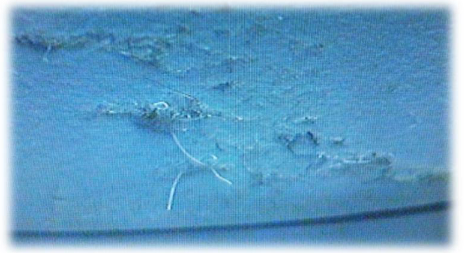
Plastics are a very soft and malleable material that’s easily damaged. Even small scrapes or scuffs are impossible to clean and sanitize. Scuffs and scrapes, as shown below, create perfect hiding places for biocontamination.
Why always dark coloured plastics?
Plastics can be manufactured in any colour. So, why do most manufactures of particle counters use black plastic enclosures for their instruments, or otherwise dark colours?
The reason is obvious and intuitive. It’s because black hides surface damage and soiled areas on the enclosure. It gives the appearance that it’s clean, but this is frequently a façade.
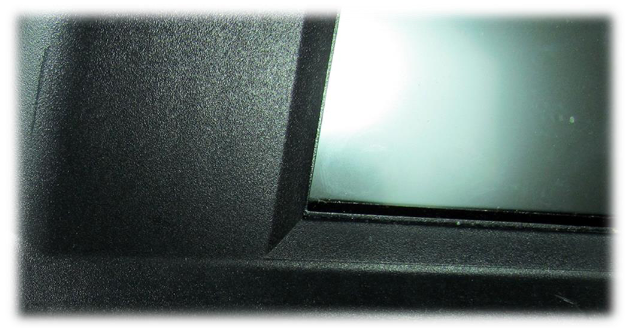
See if you can find the scuffs on the above image?
Unintended consequences on total cost of ownership
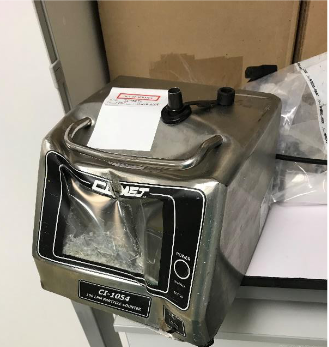
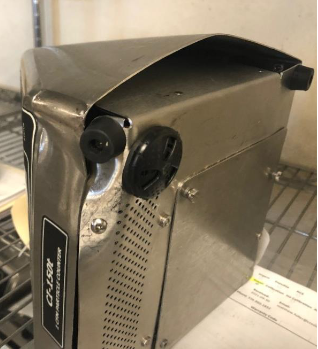
Accidents happen. Certainly, accidental drops from carts are not as uncommon as some might believe. In some cases, Climet particle counters have fallen down dumbwaiter/elevator shafts, or have been accordioned by heavy equipment (see images below).
As testament to the rugged nature of our designs, the instruments shown below passed their ISO 21501-4 ‘as found’ calibrations, albeit they obviously needed some repair work to their stainless-steel enclosures.
Regarding competitors who have plastic enclosures, even a simple drop from a cart if not resulting in catastrophic damage would certainly result in an expensive repair, plus an interval calibration out-of-tolerance condition that would further require an $8,000-$12,000 deviation report. Indeed, the cost of even a single simple failure investigation frequently exceeds the cost of the particle counter itself.
These and other Costs of Poor Quality (CoPQ) are #1 cost driver in environmental monitoring equipment.